By Arnel Mirasol
This painting exemplifies best the theme that Adam Nacianceno tackles in his Unmasked series. Unmasking involves the exposure or revelation of the true hidden self. It is the peeling of layers that opaques a hidden truth. This painting, which tells of Nacianceno's recollection of a smile, is his way of prodding us to jog our memory and recall for ourselves the selfsame experience of being smiled at. Nacianceno claims that the bliss he speaks of here is not of the physical or sensual kind which dissipates easily. He portrays here the mental or intellectual kind of bliss that fixes itself in one's mind and stays there forever. This painting is a revolving composite of faces. We see eyes that seem to be randomly placed, but are in fact components of faces masked by repeating floral patterns. The fusion here of Jackson Pollock's drip and splatter technique and a Jugendstil artist 's obsession with intricate floral drawings is what distinguishes Adam Nacianceno's art from those done by abstract painters before him. Not to mention his obsessive predilection for black and white, which make him a rare bird indeed in a Philippine art scene aswarm with colorful artistic personas laden with their colorful paintings.
.
Tuesday, September 29, 2015
Tuesday, September 15, 2015
RORSCHACHIST ABSTRACTION
By Arnel Mirasol
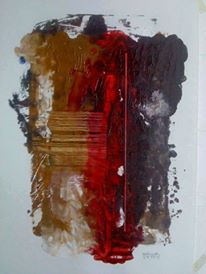
The painting above, Red Nude, is an acrylic monoprint on paper. It is part of what I call my Rorschachist Abstraction series (a few samples below) - so called because the titles I gave to the paintings in this suite were based on images I seem to discern in the finished artworks. The Rorschach or Inkblot Test, named after its creator, Hermann Rorschach, is a psychological test where a patient is asked to describe what forms he sees in mirror-image inkblot marks on paper. The psychologist then used the patient's interpretation of the marks to adjudge what that patient's state of mind or personality characteristics are. It has been used to detect latent thought disorder in people, especially in cases where patients seem to hold back, and wouldn't volunteer to describe their thinking processes openly.
Even though my paintings from 1981 to 2007 are of the realist mode, I have in my list of favorite artists ten abstractionists who I know are also masters of the realist technique - like Buds Convocar, Ross Capili, Max Balatbat, Isagani Fuentes, Fitz Herrera, Demi Padua, Allain Hablo, Gus Albor, Lao Lian Ben and Raul Isidro. Their art have inspired me, and drove me into dabbling in abstraction. With good result I guess, because after my painting Evolution of the Naos (bottom) earned accolades from an art dealer and a few fellow artists, I am now convinced that the abstract route is the one I should try to traverse from now on.
But some may question my leap into abstraction. I have been a realist painter for more than three decades now, and many art theorists look askance at painters whose shift to abstraction is rather abrupt. Well, all I can say is my shift was not abrupt, because I have been at it - experimenting in creating new forms and utilizing new techniques - since 2008. I have paid my dues, so to speak. And I can say with confidence that I have exhausted all the possibilities of realism and have nothing more to add to it.
Unlike some child abstract expressionists, or even adults for that matter, who've gained prominence lately - thanks to online hype and sleek marketing strategies - what I worried about in my early youth was how to get my drawings of the human form right. The thought of leapfrogging into being an abstract expressionist by creating art using the drip and splatter technique never entered my mind. Those "instant abstractionists" have not done right, in my opinion. They have not hewed closely to what art and being an artist is about. The word art after all was derived from the Latin ars, which means skill. Thus, a painter who aspire to do abstractions should hone his skill in drawing and realistic painting first. He should first learn the rules before daring to break them.
![]() |
| Red Nude, 2012, acrylic monoprint on paper, Ray Espinosa collection |
![]() |
| Arkong Bato (Stone Arch), 2008, oil on paper |
![]() |
| Brown Cliffs of Nowhere, 2008, oil on paper |
![]() |
| White Widow, 2012, acrylic monoprint on paper |
![]() |
Segmented Rainbow, 2012, acrylic monoprint on paper
|
![]() |
| Herodes, 2015,oil on paper |
![]() |
| Little Ben, 2015, oil on paper |
But some may question my leap into abstraction. I have been a realist painter for more than three decades now, and many art theorists look askance at painters whose shift to abstraction is rather abrupt. Well, all I can say is my shift was not abrupt, because I have been at it - experimenting in creating new forms and utilizing new techniques - since 2008. I have paid my dues, so to speak. And I can say with confidence that I have exhausted all the possibilities of realism and have nothing more to add to it.
Unlike some child abstract expressionists, or even adults for that matter, who've gained prominence lately - thanks to online hype and sleek marketing strategies - what I worried about in my early youth was how to get my drawings of the human form right. The thought of leapfrogging into being an abstract expressionist by creating art using the drip and splatter technique never entered my mind. Those "instant abstractionists" have not done right, in my opinion. They have not hewed closely to what art and being an artist is about. The word art after all was derived from the Latin ars, which means skill. Thus, a painter who aspire to do abstractions should hone his skill in drawing and realistic painting first. He should first learn the rules before daring to break them.
![]() |
| Evolution of the Naos, 2008, oil on paper |
Monday, September 7, 2015
THE SWIMMING CLASS
By Arnel Mirasol
They are lucky; my father never taught me how to swim. But I truly love the sea that I persisted in going on sea outings with my childhood friends, mostly at the breakwater just off the Manila North Harbor, where I almost drowned on two occasions. I almost got drowned again in 1988, in Oslob, while snorkeling with my compadre Roland San Mateo, who, being only an arm length's away , was there to save me.
After that, I made it a point to truly learn swimming. I hanged out at swimming pools to watch and get tips from the truly adept swimmers. I even enrolled in a one-hour butterfly-stroke course with a lifeguard in Malabon. which I successfully hurdled, that to this day I can say with confidence that I know how to do butterfly. Pabagal nga lang nang pabagal, dahil pataba ako nang pataba, (Only, I got slower because I began to grow fatter), hahaha....
![]() |
| The Swimming Class, 2002. acrylic on paper, 15.5 X 11 inches, Dr. Manolet Delfin collection |
I am a Tondo Boy through and through. It is my father, Edmundo, who is a full-blooded Cebuano. (My mother, Regina, is Tagalog.) But although I was born and raised in Manila, I still consider Oslob my hometown.
During the mid 1960s, when my father was just into a few years of working overseas as a seaman, I got the impression that he suggested to my mother that we relocate to Oslob, Cebu. My mother apparently vetoed the idea; and we siblings went along with her, not only because we were only minors then, but also because we already led a comfortable life in Tondo.
I was only a year old when my parents took me and my elder sister to Oslob for a visit. It was only in 1981, when I was already 24, that I returned there. What I saw impressed me for I have always loved the sea. There is no sea near Metro Manila that would equal the pristine, coral-laden quality of the sea of Oslob (see painting above).
After 1986, I and my wife Carina, and our two kids - Bahgee and Kai - went to Oslob whenever my father was home from his trips abroad and brought us along with him for a vacation (below). Since our house there is only about a hundred meters from the beach, our visits there were always bliss for us. My kids also love the sea. They are good swimmers, having learned the rudiments of swimming from me way back when they were in grade school.
![]() |
| In this photo from left: myself: Carina, Kai, Bahgee, John Falsis, and Dulce Falsis |
![]() |
| In this photo from left : myself, Bahgee, Beejay Labiste, Chris Einar San Agustin, and Jerry Dean |
![]() |
| Kai swimming |
![]() |
| Bahgee swimming |
After that, I made it a point to truly learn swimming. I hanged out at swimming pools to watch and get tips from the truly adept swimmers. I even enrolled in a one-hour butterfly-stroke course with a lifeguard in Malabon. which I successfully hurdled, that to this day I can say with confidence that I know how to do butterfly. Pabagal nga lang nang pabagal, dahil pataba ako nang pataba, (Only, I got slower because I began to grow fatter), hahaha....
![]() |
| Photo taken in 2012 of myself at Balaki Island, Infanta, Pangasinan |
Wednesday, September 2, 2015
ARTLETA
By Arnel Mirasol
Artleta, as you may have easily deduced, is a combination of the words Artist and Athlete (Atleta in Filipino). I coined that word to, ahem, describe myself - because aside from painting and literature, I also love sports. But artleta will better describe Francisco "Isko" de la Cruz, because he'd done feats of physical prowess which I've never done and can never hope to do. Look at what he is wearing- that's one of the many uniforms he'd collected from joining marathons. But before taking up running, Isko was first a cyclist. He is my cycling and swimming buddy. But unlike me, he's not merely a recreational cyclist. He's hardcore - he belongs to a group of cyclists (below) who have biked from Monumento to Sorsogon several times already, which distance took them four days to traverse. Their group have already gone biking to Bagac, Bataan; Jalajala, Rizal; Lucban, Quezon; and Manaoag, Pangasinan. They plan to do Monumento to Baguio next.
Isko is from Hagonoy, Bulacan. Although he is ten years younger than me, he was my classmate in Rizal Course at the University of the East, Caloocan. Don't ask me why we became classmates despite our age gap: it is a long story. Anyway, after leaving college, I again encountered Isko in a cocktail hosted by the Metrobank Foundation during their painting competition's awarding ceremony in 2000. We haven't lost contact ever since. Isko is also into t-shirt printing- a business that must be thriving because of its enormous demand on his time. He's been at it for more than a decade now, so I must say that Isko is already an expert in silkscreen techniques or serigraphy.
![]() |
| Isko dela Cruz and Mon Villanueva during the Renascence show |
The artwork he showed at Seta Pilipinas' Renascence exhibit at the Sigwada Art Gallery is titled Literati (at right). It shows an intellectual - a reconfiguration of Rodin's The Thinker sculpture - reading what looks like an encyclopedia, while holding an umbrella to ward off heavy rain represented by the literal depiction of the idiom "raining cats and dogs". True to Isko's pop art intent, this painting contains elements common to many true-blue pop art works like cartoonish animal characters, loud colors, and tongue-in-cheek narration.
Monday, August 24, 2015
ARNALDO BERNABE MIRASOL : Painter and Illustrator
![]() |
| Photo taken in 2006 of the artist in his studio |
In 1996, Mirasol showed his portfolio to Reni Roxas and Marc Singer, publishers of Tahanan Books for Young Readers. Being especially impressed by the cover art he did for Phoenix Publishing House, Reni and Marc commissioned Mirasol to do the illustrations for their collaborative book First Around the Globe: The Story of Enrique". Mirasol went on to illustrate four more books for Tahanan: Tamales Day, The Brothers Wu and the Good-Luck Eel, Once Upon a Time, and Long Ago and Far Away" (below right).
Mirasol's other books are The Origin of the Frog, Anina ng mga Alon (Anina of the Waves), and Mga Modernong Alamat (Modern Legends) Volume 4.Two of his books were prize-winners abroad. The Origin of the Frog won a runner-up award in the 12th Noma Concours for Picture Book Illustration in Tokyo, in 2000; while the excellence of his illustrations for The Brothers Wu and the Good-luck Eel landed him in the Honour List of the Basel-based International Board on Books for Young people. (below left).
Mirasol has had three solo art exhibitions, so far - once at the Hiraya Gallery and twice at the Crucible (below right). He had also participated in several group exhibitions. His paintings in the eighties, although belonging to the social-realist school, were tempered somewhat with surrealist color and humor. One of his paintings from that period, the Hungry Child Dissected, won in 1984, one of the three Best Entry awards in the First Metrobank Annual painting Competition.
![]() |
| Miss Butterfly, 2010, oil on canvas, 24 X 33 inches, Segundo Matias Jr. collection |
![]() |
| Bloody Mary, 2009, oil on canvas, 8 X 10 inches, Sari Ortiga collection |
Monday, August 17, 2015
FIRST AROUND THE GLOBE: THE STORY OF ENRIQUE
By Arnel Mirasol
Although I began doing the illustrations for the book The Origin of the Frog earlier, it was First Around the Globe which got published first, in 1997. This book was a collaborative work by authors Reni Roxas and Marc Singer, who were also the publishers of Tahanan Books for Young Readers. Reni and Marc were very generous to me. They paid me thirty-five thousand pesos for the illustrations which took me only a month to complete. That was a princely amount then, because publishers at the time will only pay twenty-five thousand pesos at the most to the illustrator. (Rex Printing only paid me fifteen-thousand pesos for The Origin of the Frog.)
The book is about Enrique el Negro.Enrique was the slave bought by Magellan in Malacca, where Magellan served as soldier. When Magellan sailed to the Philippines, he brought Enrique with him to serve as his interpreter in the islands he planned to go to. When they landed in Homonhon, an Island off Samar, Magellan realized that Enrique couldn't speak the language of the place which is Waray-Waray. It was only when they sailed to Limasawa Island in Southern Leyte and Cebu, that Enrique became useful as interpreter, because Enrique understood and spoke the language of the inhabitants there which is Sugbuanon (Cebuano). This book proposes the theory that because Enrique can speak Cebuano, he was definitely a Cebuano, and that he - not Magellan, nor Juan Sebastian Elcano - was the first circumnavigator of the world. This book tells of how Enrique was captured in Cebu by pirates from Mindanao, sold at the Malacca slave market, and brought by Magellan to Spain - from where they sailed south-westward to the tip of South America, through the South Pacific Ocean, to Guam, Homonhon, Limasawa, Cebu, and Mactan - and then Cebu again, where he presumably stayed after the death of his master.
An amusing incident involving the book was related to me by my father Edmundo. One time in the late 1990s, he was aboard a Superferry bound for Cebu. A close relative, Nick Gomocio, was with him. While sailing, they heard from the intercom a voice announcing an "on board sale" of a book. The book was First Around the Globe. When my father heard my name mentioned as the illustrator, he and Nick rushed to the book sale site, and promptly introduced himself to Reni Roxas as the father of the illustrator. Reni quickly quipped in reply: "Hindi ho maikakaila, Magkamukha ho kayo. (It can't be denied. You resemble each other.)"
The book is about Enrique el Negro.Enrique was the slave bought by Magellan in Malacca, where Magellan served as soldier. When Magellan sailed to the Philippines, he brought Enrique with him to serve as his interpreter in the islands he planned to go to. When they landed in Homonhon, an Island off Samar, Magellan realized that Enrique couldn't speak the language of the place which is Waray-Waray. It was only when they sailed to Limasawa Island in Southern Leyte and Cebu, that Enrique became useful as interpreter, because Enrique understood and spoke the language of the inhabitants there which is Sugbuanon (Cebuano). This book proposes the theory that because Enrique can speak Cebuano, he was definitely a Cebuano, and that he - not Magellan, nor Juan Sebastian Elcano - was the first circumnavigator of the world. This book tells of how Enrique was captured in Cebu by pirates from Mindanao, sold at the Malacca slave market, and brought by Magellan to Spain - from where they sailed south-westward to the tip of South America, through the South Pacific Ocean, to Guam, Homonhon, Limasawa, Cebu, and Mactan - and then Cebu again, where he presumably stayed after the death of his master.
An amusing incident involving the book was related to me by my father Edmundo. One time in the late 1990s, he was aboard a Superferry bound for Cebu. A close relative, Nick Gomocio, was with him. While sailing, they heard from the intercom a voice announcing an "on board sale" of a book. The book was First Around the Globe. When my father heard my name mentioned as the illustrator, he and Nick rushed to the book sale site, and promptly introduced himself to Reni Roxas as the father of the illustrator. Reni quickly quipped in reply: "Hindi ho maikakaila, Magkamukha ho kayo. (It can't be denied. You resemble each other.)"
![]() |
| Cover art, 1997, acrylic on paper, Marc Singer collection |
Friday, August 14, 2015
DKNY EXPRESS
By Arnel Mirasol
This painting is closely connected with two of my UST High School classmates - Arn Cruz and Ray Espinosa. The DKNY of the title doesn't mean Donna Karan New York. It is the tongue-in-cheek abbreviation, or initialism, for Divisoria Kanto ng Ylaya (Divisoria corner Ylaya) which are places in Manila beloved by bargain-hunters. I first heard of Divisoria Kanto ng Ylaya from Arn Cruz when he was driving me and another classmate home to Tondo. When I said that our house is just walking-distance from Ilaya Street, he said something to this effect, "Ah, so you live in DKNY".
My first impulse when doing this painting was to put the words "Viva Santo Nino" on the headboard of the jeepney, and title this piece Fiesta Serenade. But then Arn's DKNY joke came to mind. I adjudged then and there that DKNY Express is the better title because of its humor and wit.. Thanks Arn for giving me the idea for the title.
Ray Espinosa. on the other hand, bought this painting. There was a time during the latter months of 2013 when I really need cash fast. And to sell fast, I offered this painting at a very low price to Ray. I even included as sweeteners two of my small abstracts on paper (sample below left) to the package. What Ray said after reading my message surprised me - very pleasantly. He said that I shouldn't sell my paintings cheap, and offered 30 thousand pesos for the whole lot. Now, DKNY Express is a relatively small work, and the two abstracts are definitely small and very easy to do. (I completed them in a matter of minutes.) I've sold a painting (see bottom) slightly bigger than DKNY Express for 60 thousand pesos, but this was during a solo show, where prices are naturally higher because of the markup set by the gallery and other considerations. It therefore pleases me no end that a long-time art collector who bought from me directly would pay a relatively high price for DKNY Express..
But Ray, it seems, belong to that rare breed of art collectors, true art collectors, who buys art not for speculation or investment, but (to borrow Leonidas Benesa's words) "for their own personal delectation." He is not a bargain-hunter when it comes to art buying, Which just goes to show how high artists are on Ray's list of worthy individuals. Thank you very much, Ray.
![]() |
| DKNY Express, 2012, oil on canvas, 24 X 18 inches |
This painting is closely connected with two of my UST High School classmates - Arn Cruz and Ray Espinosa. The DKNY of the title doesn't mean Donna Karan New York. It is the tongue-in-cheek abbreviation, or initialism, for Divisoria Kanto ng Ylaya (Divisoria corner Ylaya) which are places in Manila beloved by bargain-hunters. I first heard of Divisoria Kanto ng Ylaya from Arn Cruz when he was driving me and another classmate home to Tondo. When I said that our house is just walking-distance from Ilaya Street, he said something to this effect, "Ah, so you live in DKNY".
My first impulse when doing this painting was to put the words "Viva Santo Nino" on the headboard of the jeepney, and title this piece Fiesta Serenade. But then Arn's DKNY joke came to mind. I adjudged then and there that DKNY Express is the better title because of its humor and wit.. Thanks Arn for giving me the idea for the title.
Ray Espinosa. on the other hand, bought this painting. There was a time during the latter months of 2013 when I really need cash fast. And to sell fast, I offered this painting at a very low price to Ray. I even included as sweeteners two of my small abstracts on paper (sample below left) to the package. What Ray said after reading my message surprised me - very pleasantly. He said that I shouldn't sell my paintings cheap, and offered 30 thousand pesos for the whole lot. Now, DKNY Express is a relatively small work, and the two abstracts are definitely small and very easy to do. (I completed them in a matter of minutes.) I've sold a painting (see bottom) slightly bigger than DKNY Express for 60 thousand pesos, but this was during a solo show, where prices are naturally higher because of the markup set by the gallery and other considerations. It therefore pleases me no end that a long-time art collector who bought from me directly would pay a relatively high price for DKNY Express..
![]() |
| Red Nude, 2012, acrylic on paper, 12 X 18 inches |
But Ray, it seems, belong to that rare breed of art collectors, true art collectors, who buys art not for speculation or investment, but (to borrow Leonidas Benesa's words) "for their own personal delectation." He is not a bargain-hunter when it comes to art buying, Which just goes to show how high artists are on Ray's list of worthy individuals. Thank you very much, Ray.
![]() |
| Seraglio Fantasy, 2005, oil on canvas, 24 X 24 inches |
Subscribe to:
Posts (Atom)